
The Queen of Sheba
A Queen Remembered Across Civilisations
A letter carried by a bird. A magnificent throne transported in the blink of an eye. A palace whose glass floor appeared to be made of water.
At the centre of these events stands a queen whose story has endured for thousands of years.
She was the Queen of Sheba.
Known in later Islamic tradition as Bilqis (بلقيس), she is among the most remarkable female figures remembered from the ancient world. Her story transcends kingdoms and civilisations, preserved in the sacred traditions of Judaism, Christianity and Islam.
In the Hebrew Bible, she appears as the Queen of Sheba, who journeys to Jerusalem to test King Solomon’s renowned wisdom. In the New Testament, she is remembered as the Queen of the South. And in the Holy Qur’an, she is the powerful ruler of Saba’, whose encounter with the Prophet Sulayman (Solomon), عليه السلام, becomes an account of wisdom, humility and faith.
Although the traditions differ in their details, they preserve the memory of a queen whose pursuit of wisdom would outlast her kingdom.
It is the Qur’anic account of her judgement, leadership and eventual recognition of faith that forms the heart of the story that follows.
To understand her story, we must first discover the civilisation from which she came.
The Kingdom of Saba’ — The Glory of Ancient Yemen
In the southern reaches of the Arabian Peninsula, among Yemen's mountains, fertile valleys and desert landscapes, flourished one of the great civilisations of the ancient world.
The Kingdom of Saba’, known in the West as Sheba, was a land of remarkable wealth, influence and achievement.
Its heart lay in Ma’rib, an ancient city that became a centre of commerce, political power and monumental architecture.
Saba’ occupied an important position along the ancient incense trade routes. Precious frankincense, myrrh and other valuable commodities travelled from southern Arabia towards distant markets, bringing prosperity to the kingdom for centuries.
Yet the achievements of Saba’ extended far beyond commerce.
Its people were accomplished builders and engineers. In a land where water was precious, they constructed sophisticated irrigation systems, most famously the Great Dam of Ma’rib, transforming vast areas of otherwise arid terrain into fertile agricultural land.
Their cities were fortified, their temples built from immense blocks of stone, and their affairs recorded in inscriptions that remain visible today. Their commercial and cultural connections reached across the Arabian Peninsula and the Red Sea to the lands of East Africa.
It was a civilisation whose achievements left a lasting imprint on the history of Arabia, and whose monuments still bear witness to the ingenuity of ancient Yemen.
And it is against the backdrop of this ancient civilisation that Islamic tradition places Bilqis, the Queen of Sheba.
The Qur’an describes her as a woman who had been granted great resources and possessed a magnificent throne.
Yet what distinguishes her in the Qur’anic account is not merely her wealth or authority, but the judgement she demonstrates when faced with a decision that could determine the future of her kingdom.
Her defining story begins far beyond the borders of her kingdom, in the court of the Prophet Sulayman, عليه السلام.
A Letter from Prophet Sulayman
The Holy Qur’an recounts that Allah سبحانه وتعالى bestowed great blessings upon the Prophet Sulayman, عليه السلام, granting him a mighty kingdom, profound knowledge and the ability to understand the language of animals and birds.
One day, while inspecting the birds under his command, Sulayman noticed that the hoopoe, a small bird distinguished by its striking crest, was absent.
When the bird returned, it brought news from a distant land.
It had travelled to Saba’ and discovered a prosperous kingdom ruled by a woman of great authority, possessing a magnificent throne.
But the hoopoe had witnessed something else.
The Queen and her people worshipped the sun rather than Allah سبحانه وتعالى, the Creator of the heavens and the earth.
Upon hearing this account, Prophet Sulayman, عليه السلام, entrusted the hoopoe with a letter and instructed it to deliver his message to the Queen.
When the letter arrived, Bilqis summoned the leading figures of her court.
Its words carried an unmistakable message. Beginning in the name of Allah سبحانه وتعالى, the Most Gracious, the Most Merciful, it called upon the Queen and her people not to act arrogantly against Sulayman, but to come in submission.
For a ruler accustomed to commanding a powerful kingdom, such a message presented a momentous decision.
Her advisers reminded her of their military strength and their readiness to fight, but placed the final judgement in her hands.
Bilqis understood the consequences of war.
She observed that when kings entered a city as conquerors, they brought destruction and reduced its honoured inhabitants to humiliation.
Rather than rushing towards conflict, she chose diplomacy.
She would send a valuable gift to Prophet Sulayman, عليه السلام, and observe his response.
It was a decision that revealed both caution and political judgement. Before committing her people to confrontation, she sought to understand the ruler whose message had reached her court.
But when the Queen’s envoys arrived bearing gifts, Prophet Sulayman, عليه السلام, was unmoved by their material value.
The blessings Allah سبحانه وتعالى had bestowed upon him were greater than the wealth they offered. His purpose was not to acquire the riches of Saba’.
His response was uncompromising: his message concerned something far greater than earthly possessions.
The Queen had sent her envoys to discover what kind of ruler she was dealing with. Their return made one thing clear: Sulayman was unlike the rulers she had previously encountered.
She resolved to journey to him herself.
The Magnificent Throne and the Palace of Glass
Before the Queen arrived, Prophet Sulayman, عليه السلام, gathered those in his presence and asked who could bring him her throne before she reached his court.
A powerful jinn offered to retrieve it before Sulayman rose from his place.
But another, described in the Qur'an as possessing knowledge from the Scripture, declared that he could bring it before Sulayman's glance returned to him.
And there, before the Prophet, stood the Queen's throne.
Rather than respond with pride, Prophet Sulayman, عليه السلام, recognised the event as a favour from Allah سبحانه وتعالى and a test of whether he would be grateful for the blessings bestowed upon him.
He then ordered that the throne's appearance be altered, so that the Queen's ability to recognise it could be observed.
When Bilqis arrived, she was shown the throne and asked whether hers was like it.
Her answer was neither a hasty denial nor an unquestioning declaration.
She replied that it was as though it were the very same throne.
She was then invited to enter a magnificent palace.
As she approached, she saw what appeared to be a broad expanse of water covering the floor.
Believing she would have to pass through it, she lifted her garments, uncovering her lower legs.
But there was no water to cross.
Prophet Sulayman, عليه السلام, explained that the palace was paved with smooth glass.
Bilqis had arrived as the sovereign of a prosperous kingdom, accustomed to the wealth and splendour of royal courts. Yet her encounter with Prophet Sulayman, عليه السلام, had challenged her understanding of power, knowledge and faith.
Recognising the truth of the message brought by Prophet Sulayman, عليه السلام, she made a declaration that would be remembered for generations.
رَبِّ إِنِّي ظَلَمْتُ نَفْسِي وَأَسْلَمْتُ مَعَ سُلَيْمَانَ لِلَّهِ رَبِّ الْعَالَمِينَ
“My Lord, indeed I have wronged myself, and I submit with Solomon to Allah, Lord of the worlds.”
With these words, Bilqis acknowledged Allah سبحانه وتعالى and submitted to Him alongside Prophet Sulayman, عليه السلام.
The encounter had begun with a letter delivered by a bird to a distant kingdom.
It did not end with a battle or the destruction of her kingdom, but with the Queen’s declaration of faith.
Her story remains an account of a ruler who exercised judgement in the face of conflict, sought counsel before deciding and ultimately embraced the truth when it became clear to her.
It is this legacy, more enduring than the splendour of her throne, for which Bilqis continues to be remembered.
The Throne of Bilqis — A Legacy Carved in Stone
Although the precise historical identity of Bilqis is debated, the civilisation of ancient Saba’ left behind a rich archaeological legacy.
The Queen’s legacy is preserved not only in sacred texts and traditions, but also in the names attached to Yemen’s landscapes and monuments.
In Ma’rib, the historic heart of the Sabaean kingdom, the remains of ancient temples, cities and monumental structures still bear witness to a civilisation that flourished more than two thousand years ago.
Among these monuments stands the Bar’an Temple, traditionally known as Arsh Bilqis (عرش بلقيس) — the Throne of Bilqis.
With its towering stone pillars and monumental architecture, the temple is among the most recognisable surviving symbols of the ancient Sabaeans.
An ancient religious monument, the temple’s traditional name reflects the place Bilqis continues to occupy in Yemen’s cultural memory.
In 2023, UNESCO inscribed the Landmarks of the Ancient Kingdom of Saba, Ma’rib, on the World Heritage List, recognising their outstanding historical, architectural and technological significance.
For Yemen, these monuments represent far more than the remnants of an ancient civilisation.
They are tangible reminders of the achievements, sophistication and cultural influence of a kingdom whose history reached far beyond southern Arabia.
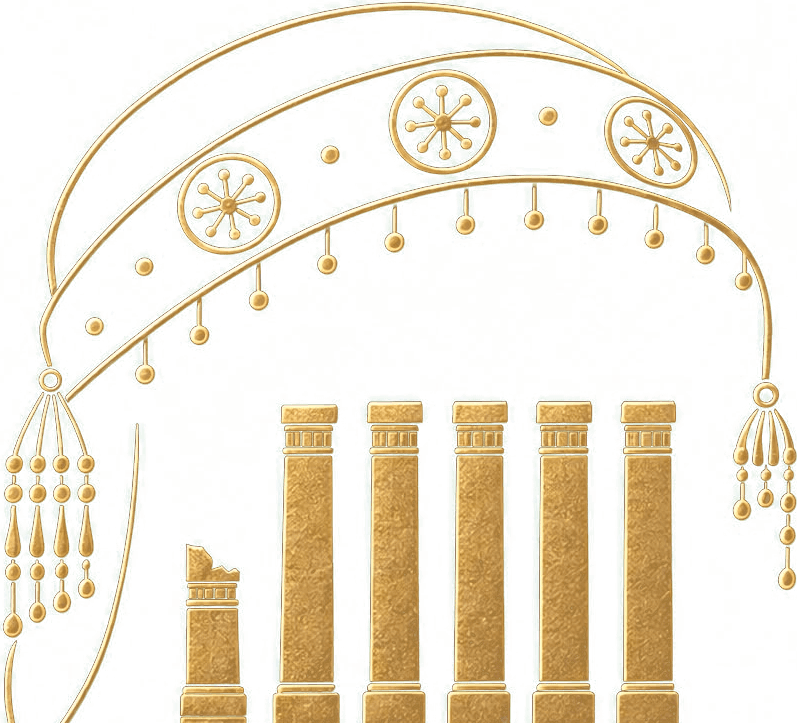
We drew inspiration from these very pillars of the Bar’an Temple for Queen of Sheba's emblem.
Their distinctive form became part of our restaurant's identity, connecting our name to the history and heritage of the civilisation from which its inspiration comes.
The temple’s association with Bilqis is important to us, but its significance reaches further: it represents a chapter of Yemen’s history that deserves to be recognised, remembered and shared.
Our emblem is a small tribute to that history, and to the heritage we are proud to carry forward.
Why We Carry Her Name
When our family opened Queen of Sheba in London in 2005, Yemeni cuisine had no presence in the city's restaurant scene.
We wanted to change that.
We opened London's first restaurant dedicated to Yemeni cuisine, with a simple ambition: to introduce people to the food, traditions and hospitality of the country we came from.
Not by changing our cuisine into something more familiar, but by sharing it as we knew it.
The dishes prepared in Yemeni homes. The aromas of spices and freshly baked bread. The generosity of a table around which family, friends and guests gather.
These were the traditions we wanted to bring to London.
In Yemen, sharing food has always been more than serving a meal. It is an expression of generosity, a way of welcoming others and bringing people together.
Yemen’s heritage reaches from the great kingdoms of ancient Arabia to the customs and traditions preserved through generations.
And when it came to choosing a name, we wanted one that represented something greater than the restaurant itself.
The Queen of Sheba embodied part of that inheritance: the memory of powerful kingdoms, flourishing trade, architectural achievement and a story remembered across three Abrahamic faiths.
Her name connected the ancient past to the culture and traditions we were proud to share.
It was this history that inspired our name, and the spirit of Yemeni hospitality that inspired our restaurant.
More than twenty years have passed since we first opened our doors.
In that time, we have welcomed generations of customers, introduced countless guests to Yemeni cuisine and remained a family-run restaurant, rooted in the same traditions with which we began.
The city around us has changed. Yemeni cuisine has become more widely recognised, and new generations have discovered the dishes that have long been part of our culture.
But our purpose has remained the same.
To preserve the flavours and traditions we inherited, to welcome our guests with the generosity that defines Yemeni hospitality, and to share something of a country whose history reaches far beyond what many know of it.
Centuries separate the great civilisation of Saba’ from the London restaurant that carries its Queen's name.
Yet the history, traditions and heritage of Yemen remain at the heart of everything we do.
It is a heritage we are proud to come from, and one we are honoured to share with every guest who joins us.
Welcome to Queen of Sheba.
Sharing the heritage and hospitality of Yemen since 2005.